
Ah, website AI. That polarising, often misunderstood topic that no business can escape, wherever they sit on the scale between teeny tiny micro business and mega monopoly.
Just a few years ago, the concept of machine-generated websites – code, content, branding and all – was sci-fi to the average person. Today? Even non-digital natives are giving it a go. If I went back in the TARDIS to tell my past self who started up this agency before the birth of Google (yep, we’ve been going for that long!), it would send him into a coma.
The big question on many professionals’ lips, our prospective clients included, is: now you can prompt websites into being, is human expertise still vital?
To get to the bottom of all the conflicting website advice and give you a truly honest, nuanced answer, I pooled all of my knowledge and experience in website AI, plus years of hand-crunching code, into this one-stop explainer.
Skip to:
- The Bottom Line
- Narrowing down ‘AI’: How is AI Being Used in Website Design?
- Is AI Web Design Worth It?
- Must-Know Website AI Caveats
- Do Human Web Designers Still Have the Advantage Over AI?
- The Future of AI in the Website Design Space
- Conclusion
I’ve been in the business of websites since 96’, meaning that I’ve seen more industry disruptions than you can shake a stick at: Flash, JavaScript, smartphones, eCommerce and then social commerce, drag-and-drop website builders, Google Translate… the list goes on.
Each revolutionised the internet in different ways, but few in such an existentially big way as generative AI. If AI can increasingly take care of the coding, copy, visuals and generate website recommendations, where does it leave us web designers?
I’d argue that we’re more important than ever. Because the real opportunity is to use it to make user experiences (UX) more impactful, accessible, efficient, consumer-friendly and innovative, by combining AI might with rich specialist insight, the experience-rooted things the technology can’t replicate: human judgement, empathy and creativity.
The Bottom Line
- AI-generated websites will only get you so far, and the quality isn’t guaranteed. As outsiders will quickly learn, building, hosting and management are very different responsibilities that AI can’t automatically replace.
- It requires considered human oversight and quality control to develop your site’s technical capabilities creatively, whilst protecting your brand from compliance issues and your visitors’ security and right to privacy.
- One-click, generated sites, naturally, have a “cookie cutter” look to them, which in certain sectors could damage your brand image and audience trust. Others can be extensively customised when you go beyond basic prompts or standard templates.
- A speedily prompted site is swift in the moment, but may demand rework in the long term, all exacerbated by a knowledge and/or documentation black hole.
- If something goes wrong, you might not have the understanding or wherewithal to put it right on your own. The AI can’t find or fix a bug? Then you’re a bit stuck.
- Combining AI brawn with human brains takes a website from technically “okay” (read: functional yet bland) to a conversion-capturing, competitive asset that does the selling for you.
Narrowing down ‘AI’: How is AI Being Used in Website Design?
Enough with the sweeping statements. “Artificial intelligence is taking over the world”, this; “traditional web design is dead”, that. Let’s get into the concrete stuff. How exactly is AI changing the way websites are built, managed and interact with the broader web ecosystem?
Automated tools
GenAI has officially embedded itself in the UK workforce; almost one in five British employees use it daily to support their work as per a 2026 PwC survey of 2,000+ UK workers. As you might imagine, the adoption in techy spaces, including our own Vital HQ, leads the pack.
As such, automations are becoming indispensable to the software developer’s toolkit; here, I’m talking about the AI-charged apps that speed up menial, Ctrl-Z-Ctrl-F tasks.
For example…
- Workflow automation, connecting up integrations on the admin side
- Task runners, which handle repetitive tasks across massive datasets – think minifying CSS or JavaScript files, optimising 1000s of products’ metadata or upscaling images
- Autonomous testing tools that run in the background, conducting routine technical checks and finding web page errors
- The gazillions of specialised plugins for your content management system (CMS), which support the building, customisation and user experience of your website, from content marketing to extra features
Using these tools in this way is what I’d term responsible AI-assisted development, where AI tools act as collaborators or “pair programmers”. Its counterpoint is “pure vibe coding”, which AI researcher Andrej Karpathy describes as instilling complete confidence in AI’s raw output, “forgetting that the code even exists.”
AI Website Builders
With a global market clocking 3.41bn USD as of 2026, these bad boys are the frontier of technology.
Just this year, Microsoft Copilot, OpenAI’s Dots and Meta with Muse have released new agentic models that have changed the rules of productivity. Though not website builders in their own right, they’re a potent supplement. Throw the growing pool of ever-sophisticated, dedicated generative UI tools into the mix, and the website AI race just got personal for web designers.
These applications are like having a developer in your pocket; they let non-coders build entire websites, apps, plugins, dashboards, among other automations with a simple set of instructions. Note: in mere minutes.
Originally, the quality was… questionable to say the least, but after a few years of iteration, these tools are shaping up to be very powerful. Some are even capable of optimising design around user behaviour, so repeat visitors will encounter hyper-personalised interfaces based on their past activity. Such developments are set to materially change the industry, and could seriously democratise how businesses approach website creation.
AI Agents & the Changing Search Landscape
As Marshall McLuhan famously said, “the medium is the message.” By this, he meant that a method of communication more profoundly shapes the content it relays than the message itself. The TV turning news into entertainment is a clear-cut example. When we look at AI’s transformation of Search behaviour, it absolutely tracks.
With the introduction of Google’s AI Mode, AI Overviews and large language models (LLMs), the search ecosystem has become more personalised, more conversational, more intelligent. Consequently, people are leaning into new modes of discovery, searching, scrolling, streaming, and prompting their way through the buyer’s journey, often bypassing traditional search engines altogether.
The key thing is that more consumers are discovering brands through AI recommendations, citations and summaries, which in turn requires websites to be properly structured and technically marked up so they are more easily surfaced, crawled, parsed and thereby suggested by the technology. And that’s just the tip of the AI optimisation iceberg…
AI agents (also increasingly common) go a step further than just finding and summarising information. They also need to navigate your site and use its features to complete tasks on users’ behalf. This could be a complex product or supplier comparison, or something as simple as a form fill. Nonetheless, it calls for an overhaul of your SEO practices and agent-ready design, which of course, shouldn’t compromise the site’s user-centricity.
Content
I won’t go into the weeds with content marketing, because really this is a completely different topic unto itself. (Go check out our guide if you’re interested!) However, it is worth pointing out that innovations in LLMs and CMS plugins are making the writing of web pages and their constituent copy easier and faster.
Need something to quickly whip your draft into shape? Or perhaps generate thousands of product headlines that are unfeasibly done in-house? Ask AI.
A word of warning, though: popping all of your copy on autopilot won’t do you any favours, neither in the eyes of search engines nor your customers. You lose the differentiator factor of being uniquely you, in tone and message, to the horror of your marketing department. And your brand story is diluted, with no real SEO gain – yep, Google actively penalises substanceless, mass-generated content that tries to game the system (AKA scaled content abuse), so don’t go all content farm with your site.
Worst of all, it may negatively affect your customers’ confidence in your brand. According to data from Klaviyo’s 2026 Consumer Trends Report, 32% of the 8,000+ global consumers they surveyed expressed distrust in AI-generated marketing content.
So, Is AI Web Design Worth It?
Deciding whether something is objectively good or bad is never helpful. I’ve always found an old-fashioned risk-reward analysis far more valuable. So, whilst there are two simultaneous arguments happening;
- AI will make human web developers obsolete
- AI tools are all ‘slop’ and experienced developers don’t need them
Like life, the truth is a lot messier.
Instead of giving credence to polarised talking points, I’d urge folks to read the following considerations and apply my wisdom to your specific circumstances.
Where It Is Genuinely Helpful
We’ve thoughtfully adopted AI tools at Vital Agency. Naturally, that looks like the considered automation of tasks that eat up considerable time without adding proportionate, human-derived value. Things like automated redirects for large sites with hundreds of pages, which take us out of the spreadsheets and into the codebase, where our specialism is best applied.
I welcome AI into the non-strategic – let’s be honest, mindless – parts of the work. For example, punching out simple boilerplate code, drafting a wireframe template, or producing placeholder text that goes to a copywriter who will work their magic on it. Starting points, rather than the finished product.
All of the decision-making, quality control, creative elements and technical labour stays with the team, so our clients enjoy faster turnarounds, zero drop in quality.
What AI Can’t Do
To be blunt, many models are still godawful at decision-making, and understandably so.
AI can’t tell when a layout is technically correct but feels stale; it doesn’t know where to intentionally bend the rules of writing to deliver a salient, emotionally rousing point; it certainly can’t pull on longstanding client relationships to tease out the nuanced preferences of your C-suite and make the right technical compromises based on layers of organisational context.
This is why many of the websites spat out wholesale by AI are so – *yawns* – uninspiringly generic. And, in the long term, they are much more annoying to expand alongside a growing business, given machine-written code’s propensity to break at scale.
For DIYers
Small-scope projects are totally fine to offload to an AI website builder, though perhaps not for end-to-end creation if you want your brand to stand out. At the very least, write your own words so your brand aura shines through or hire a professional copywriter to ventriloquise them.
For Brands Seeking to Scale
As I just mentioned, a one-click website is not fit for purpose if your business sits at the enterprise end of the spectrum or is seeking a bespoke solution that will flex and grow alongside you.
If your company operates within a regulated market dealing with sensitive user data, doubly so, as the combination of missing human-imposed guardrails and potentially patchy code is a compliance issue in waiting. Here, documentation that your website team understands and a robust accountability structure are vital.
AI is undoubtedly an essential tool for your developers, but it’s best employed to enhance and facilitate their deep expertise to avoid these problems. Plus, with a completely bespoke design built from the bottom up, you get the assurance of human accountability through your developer team, rather than a faceless entity.
Must-Know Website AI Caveats
The short answer: just because you can doesn’t mean you should. Fleshed out further, letting AI completely take the reins of your website development isn’t always the right decision, particularly if individuality, complex features and technical longevity are your no.1s. Granted, it’s fast, but the results can be mixed. Case in point:
- Quality code isn’t guaranteed
- To achieve a more unique, personalised UI, you need to know what to ask for when prompting, and how to do it well
- An emerging pool of research has found that AI-authored code, although accelerating output, can amplify certain categories of mistakes. For instance, a CodeRabbit analysis of 470 GitHub repositories found an average of ~1.7x more errors in machine-written code across every major category of software quality. Findings echoed in an empirical analysis of 6,275 GitHub repositories.
- AI can’t take on all of the responsibilities of hosting and management too
- Nor can it decide what outcomes matter as humans do
- Baseline knowledge is necessary to tackle complex bugs, edge cases and security issues
- Poorly implemented AI code may cause additional work and expense later down the pipeline
- The lack of human-imposed guardrails raises privacy, compliance and security risks
- AI can sometimes throw a spanner in the works for accessibility (though it can also be pretty helpful)
- If you’re outsourcing to a developer, those with less experience can mask poor, low-effort work with a convincing frontend veneer
- Using a popular model shared by your competitors can lead to homogenisation and prevent you from standing out
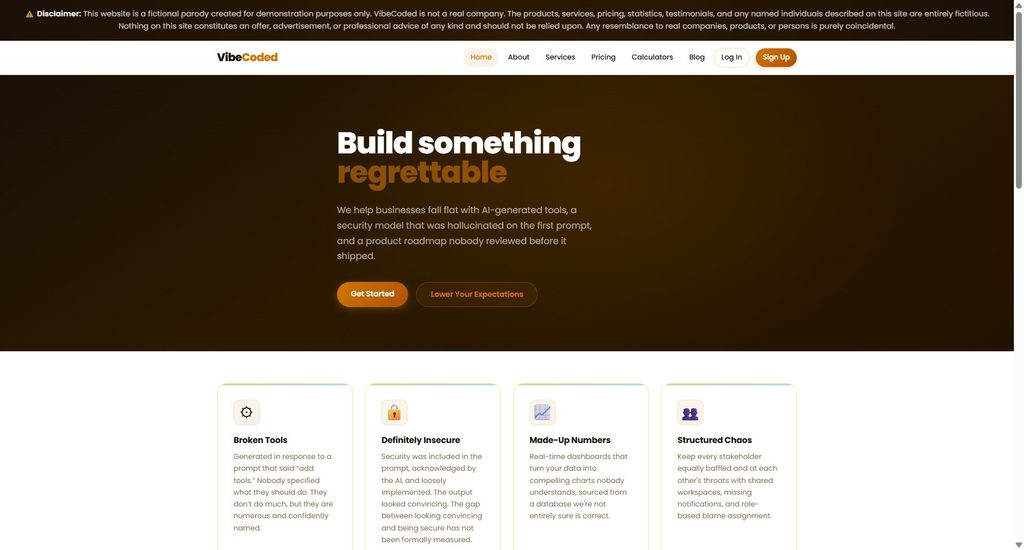
All in all, there’s just as much risk as reward when you don’t tailor your prompts just so. This vibe-coded website parody below takes that notion to its logical extreme.
Do Human Web Designers Still Have the Advantage Over AI?
Right now, I’d say so. AI is a powerhouse, but it’s not infallible (hence the ire it can attract from naysayers).
To avoid rework and extra expense down the road, it’s a good idea to entrust your site to the capable hands of a reputable agency that understands how to balance your budget and technical requirements with timely, effective delivery.
You get the speed and ‘muscle’ of AI-assistance with the irreplicable judgement, creativity, knowledge and experience of humans. Win-win!
The Future of AI in the Website Design Space
The full potential of AI web design is unknowable right now. The future of website development as a whole, though? To me, it’s looking like the industry will find a sweet spot synergy between human ingenuity and discernment, and machine intelligence. There may be more prompting on the horizon, to be sure, but expertise will remain priceless, as a clear understanding of logic and troubleshooting is necessary when automation falls short.
Conclusion: AI is Shrinking the Website Skills Gap, But the Value of Humans at the Helm Holds Up
Like drag-and-drop website builders before them, AI can address the skills gap between no-code developers and those with computer programming backgrounds – except, now, the possibilities are tenfold.
Clean-looking, functionally sound web design is more accessible than it’s ever been. But considering the high-stakes business decisions and our increasingly competitive world, human judgment, guardrails, creativity and empathy are ever more valuable.
So, as the internet and websites inevitably move towards more conversational, automated models, being able to identify the qualified, accountable human at the helm will prove vital.
Eager to start your own project with all this talk of websites? Pop in for a chat or give me a ring.
Frequently Asked Questions
Website AI refers to artificial intelligence tools used to design, build, manage and optimise websites. These include AI website builders that generate layouts and code from text prompts, automated testing tools, content generators and AI-powered development assistants. Businesses can use website AI to speed up development, automate repetitive tasks and improve efficiency, although human oversight remains important for quality, security and usability.
Yes, AI website builders can generate complete websites from simple text instructions, including page layouts, code, images and written content. Some tools can also create interactive features and applications. However, generating a functional website doesn’t guarantee that it’s secure, accessible, scalable or aligned with your brand. More complex business websites typically require professional testing, customisation and ongoing maintenance.
Not necessarily. AI website design can be faster and more affordable for simple projects, particularly for small businesses with limited budgets. However, professional web designers bring strategic thinking, creativity, technical knowledge and an understanding of customer behaviour that AI cannot reliably replicate. For businesses requiring distinctive branding, complex functionality or long-term scalability, combining AI tools with experienced web designers is generally the stronger approach.
The main risks of AI-generated websites include poor-quality code, security vulnerabilities, accessibility problems, generic designs and limited scalability. AI tools can also produce errors that are difficult to diagnose without technical knowledge. Businesses handling sensitive customer information face additional privacy and compliance considerations. Professional oversight, thorough testing and ongoing maintenance help reduce these risks.
AI-generated websites can perform well in search engines if they’re technically sound, accessible, fast and provide genuinely useful content. However, using AI doesn’t automatically improve SEO rankings. Poor site structure, duplicated or low-quality content, technical errors and weak user experiences can negatively affect search visibility. Businesses should combine AI-assisted development with established SEO practices, original content and human quality control.
AI is changing how websites are designed and developed, but it’s unlikely to eliminate the need for skilled professionals entirely. AI can automate coding, generate layouts and accelerate routine development tasks, while human designers and developers provide creative direction, strategic decision-making, complex problem-solving and accountability. As AI technology advances, web professionals will increasingly focus on using these tools effectively rather than performing every task manually.


