
Since the earliest days of the internet, savvy business minds have been leveraging digital channels to capture attention, build trust, sculpt a reputation for themselves, and warm up leads until they’re piping hot. One of the most influential and, get this, profitable strategies of the bunch is content marketing.
A veteran in the digital marketing field, it has weathered countless disruptions, merging with SEO and now AI optimisation best practices to keep content relevant, discoverable and effective.
If you, too, want to attract and convert leads/shoppers and you’re ready to play the long game, sharp, targeted content is the most sustainable approach. In this entry-level guide, I’ll explain why, and share some strategy titbits I’ve picked up in my 25 years helping businesses grow.
Skip to:
- What Exactly is Content Marketing?
- Telling You Straight: Is Content Marketing Worth It?
- Types of Content Marketing
- Contemporary Content Marketing Challenges
- Springboard Strategies to Give a Go
- Conclusion: Feeling the Strain? Maybe It’s Time to Outsource
What Exactly is Content Marketing?
Just about every business is pumping out content, left, right and centre. (Well, for some, it’s more like a trickle.) Nonetheless, in 2026, 45% of businesses are exploiting the potential of their websites, blogging and SEO. But what actually is content marketing in the digital marketing field?
To get straight to the point, it’s all about using content strategically to attract and convert potential customers to your brand. The key difference between this slow-burn approach and traditional advertising, which typically interrupts users to push a message, is that content marketing meets them where they’re at. No pushy sales pitches or annoying ads, just helpful, authoritative content your audience is actively seeking out.
Here, the effect is trifold:
- It brings in organic traffic, the people already searching for solutions and insights connected to your knowledge and offering
- These people are more likely to trust your expertise and experience, since they’re already warmed up and open to converting
- You’re not wasting time chasing or filtering out ice-cold leads that go nowhere
A quick aside: It goes without saying, your business presence isn’t going to blast off overnight with a single piece of content, however well-crafted it may be. But you can experience long-term growth, over months and years, as the initial effort you poured in compounds traffic, clicks and conversions.
Telling You Straight: Is Content Marketing Worth It?
Ah, isn’t that a big question? Well, businesses are asking it more and more every day, some of my clients included. And, no surprise, the culprit is usually AI.
The most astronomical disruption to the industry, up there with the rise of influencers and Google’s biggest algorithm updates, generative AI is now used for content creation by 80% of marketers. Surely, this renders your content team obsolete?
On the contrary, humans at the helm have never been more important; 63% simultaneously say they need more unique, homo sapien-centred content to stand out. Regardless, the strategy is a source of serious traffic, trust, brand reputation and conversions, and that’s not likely to change.
Long-Term Benefits You’ll Reap
Beyond the content marketing benefits I’ve mentioned thus far, there’s a whole cocktail of rewards to enjoy if you do it well.
- Content marketing and SEO go hand in hand: Optimise your copy for search engines and AI chatbots, and you can get your brand mentioned in the search results or even recommended by ChatGPT. The better the content, the longer website visitors linger, and that means better odds for ranking – the feedback loop chugs along.
- A marker of activity, care and professionalism: Consistent, high-quality content signals to both people and ranking algorithms that you put effort into what you do and that you have a meaningful take to share.
- It’s insanely cost effective: Content marketing pays for itself in the long run via improved visibility, more valuable leads, conversions and sales.
- Content is an asset that accrues value over time: Yep, it builds compound interest, and you can revisit it with optimisations to make its reach go even further.
- You control the narrative and thus your reputation: Content marketing is the perfect opportunity to sculpt your brand narrative and keep your reputation gleaming. And perhaps even share a glimpse of your scintillating personality.
- It presents a handy repurposing opportunity: A core piece of long-form content serves as a foundational knowledge hub, which can be repackaged elsewhere, in social media posts, press releases, newsletters & more.
- Content marketing feeds into your other marketing activities: Since customers rarely make decisions based on one-off interactions, traveling along twisty paths to purchase, your content may well inform their choice to convert at a later touchpoint.
- It boosts retention: Struggling with customer churn? Quality content can deepen engagement and keep them sticking around, even after purchase.
Cost-Benefit Analysis
So, here’s the thing: content marketing clearly takes time and effort. Immediate wins are out of the picture, with the average campaign taking 3-6 months to show any perceivable results and up to a year for your ROI to spike. Another downer, the initial investment can be hefty, depending on your ambitions and the scope of your plan. Pair it with other spends like SEO, and that’s quite the down payment.
However, they don’t say patience is a virtue for nothing; content marketing can feel expensive from one side of the tunnel, but looking back with the results rolling in, it feels very different. Keep your output consistent and invest appropriately, and the results are far more hard-hitting than your traditional marketing methods, not least because they’re stable and effective long after you hit publish.
Types of Content Marketing
You probably gathered this from the outset: there are many types of content marketing. After all, ‘content’ is such a sweeping term in digital marketing. Let’s take a brief look at your available options, and how they might square up against your objectives.
| Content Format | Description | Works Best… | Quick Tips |
| Blog | The place to build credibility and demonstrate thought-leadership. Your traditional blog posts, including guides, how-tos, listicles, round-ups and pillar pages. | For lead generation, SEO, building topical authority, and educating prospects throughout the funnel. | Focus on search intent, target relevant keywords for each page, use snappy headlines to capture attention, and include plenty of internal links. |
| Videos | Short-form or long-form video content including explainers, demos, webinars, interviews and tutorials. | For boosting engagement, humanising your brand whilst building awareness, product education, and social reach. | Hook viewers in the first 3–5 seconds, add captions for accessibility, repurpose clips across channels, and keep messaging concise. |
| PR & News | Newsworthy content designed to set the agenda. Press releases, company announcements, thought leadership, media features and commentary. | For demonstrating responsiveness and topical knowledge, brand visibility, backlinks, and reputation building. | Be very precise with your angle, offering a unique insight into broader trends. If pitching, tailor your messaging to the relevant journalist and/or publication. |
| Podcasts | Audio content such as interviews, panel discussions, solo commentary or educational series. | For thought leadership, increasing blog engagement, audience loyalty, and deeper storytelling. | Prioritise audio quality, maintain a consistent release schedule, and pair with other formats like blogs (summaries) or social media (clips). |
| Social media | Organic and paid posts across platforms like LinkedIn, Instagram, TikTok, X and Facebook. | For community building, real-time engagement, brand personality, and content amplification. | Speak your audience’s language and get to grips with each platform’s quirks. |
| Infographics | Visual content that simplifies complex information, statistics or processes into easy-to-share graphics. | For backlinks, topical authority, education, and summarising data-heavy topics. | Employ design best practices, such as visual hierarchies, using empty space, keeping copy minimal and designing them for mobile readability. |
| Gated content or lead magnets | Downloadable assets such as ebooks, whitepapers, templates, checklists or reports that require contact details to access. | For lead generation, nurturing prospects, and capturing high-intent audiences. | Offer genuinely useful value, keep forms short, and align the asset with a specific buyer pain point. |
| Email marketing | Newsletters, product updates and promotional campaigns sent directly to subscribers. | For retention, nurturing leads, recapturing abandoned baskets, conversions, and driving repeat engagement. | Segment your audience(s), personalise subject lines, don’t over-email, and focus on one clear CTA per email. |
| Interactive tools / elements | Bespoke tools like pricing estimators, quizzes, product amount calculators and assessments. | For enterprise buyers after accurate ROI estimates, lead generation, conversion optimisation and personalised user experiences. | Prioritise creating instant value by anticipating user pain points and strive to keep inputs simple. |
Contemporary Content Marketing Challenges
With the content ecosystem thoroughly shaken up by changing consumer behaviour (thanks AI), there are more hurdles for businesses to clear than ever before. But it’s not all bad. With a solid understanding of where most small businesses, mid-market and enterprise brands struggle, you’ll know exactly where to focus the brunt of your attention and budget.
Here are the top 5 challenges Hubspot uncovered in their 2026 State of Marketing Report.
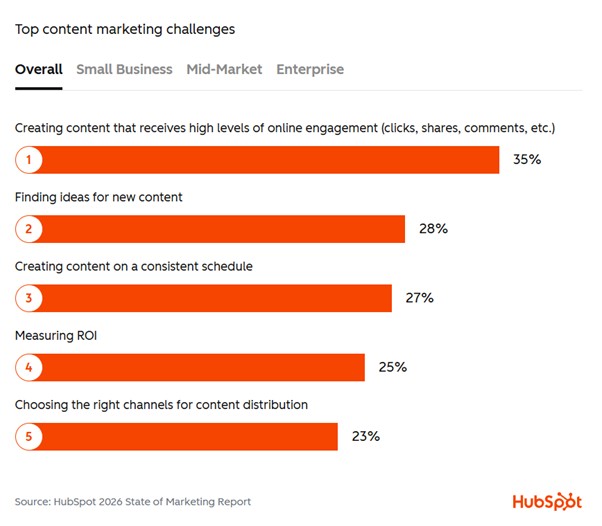
Besides these common challenges, I also wanted to spotlight a handful of pitfalls I’ve personally seen companies fall into.
- Relying too heavily on AI: Generative AI is useful up to a point and should be considered a tool and advisor, rather than a shortcut to pumping out content 24/7. Sceptical readers can spot ChatGPT tells at a glance, which can seriously erode trust. So drop the “it’s not x, it’s y” cliches, and write in your own voice, using tools to refine it, not erase it.
- Putting quantity over quality: Jumping off from the previousmistake, a flood of content doesn’t necessarily equate to an inflation of attention and conversions. Sometimes a handful of highly targeted, well-made articles outperform a plethora of slapdash content created just for ranking’s sake.
- Neglecting the user experience: If you don’t have your technical foundations and the right features in place – think, a fast-loading, mobile friendly blog architecture – your content won’t be given the time of day. Here, I’d recommend a UX audit.
- Writing with an insider hat on, and not from the audience perspective: When you’re up to your eyeballs in your specialism, it’s easy to revert to jargon and complexity that flies over your customers’ heads. Remember, everything should circle back to your audience’s needs. Align your language and info with their intent, and bob’s your uncle, your content will be much more effective.
Springboard Strategies to Give a Go
Before I go, take stock of these simple strategies to become more content with your content. Exactly like I said in our social media outsourcing guide, you absolutely can’t rely on posting alone; a tactical direction based on real user behaviour and tangible KPIs is the baseline for success.
- Get to know your audience on a granular level by crunching the data: Who are they according to demographic info? How are they spending time on your site? What messages, insights, knowledge and solutions resonate?
- Invest some time in upskilling; SEO best practices and copywriting proficiency are an investment you can’t put a price on.
- Map your content onto the marketing funnel, from brand discovery to decision stages: This will help align your output with your audience’s headspace, ensuring it has a refined purpose and meets their needs and expectations.
- Find your audience where they’re already spending their time: Your customer base’s make-up dictates their consumption habits, which should inform your campaign reach. For instance, a B2B audience may be more inclined towards educational content, compared to eCommerce customers.
- Never market blind – metrics are your lifeline: Set specific goals based on relevant performance metrics, which reflect the intent of your content, and continually review your progress. Improve, iterate, repeat.
- Avoid siloing your content: Your digital marketing mix should include a variety of content across several channels, so you hoover up all of the most valuable leads. Ideally, you should be creating a consistent experience at every touchpoint, from socials to emails and beyond, every interaction positively reinforcing users’ perception of your brand.
Conclusion: Feeling the Strain? Maybe It’s Time to Outsource
Even seasoned content marketers have their content fatigue days, so rest assured, you’re not alone if you’re feeling the pressure. Although it’s easy to succumb to the allure of AI-generating blogs, website copy, social media captions and the like, it’s not going to make your brand stand out, nor rank in Google for that matter!
The solution? If your budget allows, moving the burden from in-house shoulders to professional ones is always a smart move. *Ahem* At Vital Agency, it’s our speciality.
Elevating generic copy with words that cut through, all on a bedrock of data and tactical analysis, we’ll whip your content marketing strategy into shape. And ensure it sits strategically within your broader digital marketing plan. Fancy a chat? Get in touch.
Frequently Asked Questions
Content marketing is the strategic creation and distribution of valuable, relevant content designed to attract, engage and convert a target audience. Unlike traditional advertising, it focuses on educating or helping users rather than directly selling to them.
Content marketing is a long-term strategy. Most businesses start seeing measurable improvements in traffic, rankings and engagement within 3–6 months, while stronger ROI and authority often build over 6–12 months with consistent effort.
Blogs, pillar pages, guides and educational resources tend to perform best for SEO because they target search intent and allow you to build topical authority. Supporting formats like videos, infographics and interactive tools can also improve engagement and dwell time.
Not necessarily — but relying entirely on AI-generated content can hurt quality, originality and trust. Search engines increasingly reward content that demonstrates genuine expertise, experience and unique insights, so human editing and strategic oversight remain essential.
The best content mix depends on your audience, goals and industry. For example, B2B brands often benefit from blogs, whitepapers and LinkedIn content, while eCommerce businesses may see stronger results from videos, social media and email marketing campaigns.


