
Budgets are boring, I know. Snore. But in the arena of digital marketing, they make the world go round – and nowhere quite as obviously as pay-per-click advertising (PPC). While budget alone doesn’t dictate success, every ad’s position, reach, and scalability are influenced by it, which begs the question: how much does Google Ads cost?
Annoyingly, there’s no cut-and-dried answer we can proffer up, just that it really does depend. But don’t worry, there are plenty of ways to work out whether paid Search is within your means.
Enter this vital Google PPC price breakdown, where I’ll be giving a run-down of the average Google Ads cost by industry, essential factors to get a handle on, plus some revenue-increasing tips we’ve used over the last 25 years to drive website visits, leads and conversions for our lovely clients.
There’s no time to lose – let’s get into it!
Contents:
- TL;DR
- Why Google PPC Prices Matter
- A Refresher on How Google Ads Pricing Actually Works
- Average Google Ads Cost in the UK
- Cost Drivers that Make All the Difference
- DIY Versus Managed
- Conclusion: Deciding Whether the Price is Worth It
- FAQs
Why Google PPC Prices Matter (Especially in 2026)
To the small, and even medium-sized players, Google Ads can feel like a rigged game: fewer consumers pay ads any attention, it’s pretty oversaturated, and a steady drip of changes to the Search ecosystem (thanks, AI…) is forcing businesses to pivot their strategy.
Yep, it’s not surprising that many of our clients are asking the same question: Is Google Ads still worth it in 2026?
Well, it certainly can be profitable. It’s well known that, across industries, businesses generally earn $2 in revenue for every $1 spend, provided the data is good, and the Ads management is robust. But, given the aforementioned hurdles and the ominous fact that CPC is still increasing in competitive UK markets, it’s understandable why some managers might be put off.
My two cents are that as the competition continues to rise, automation keeps making strides and margins for error shrink, it’s time to dig deep and not check out. Google Ads’ prices influence the lucrativeness, visibility and efficiency of your digital marketing efforts. With a solid understanding of how they work and what you can do to make your campaigns go further (that other brands are neglecting), you’ve got a real opportunity to come out on top.
A Refresher on How Google Ads Pricing Actually Works
Feel a bit rusty, or perhaps it’s your first time getting acquainted with Google Ads and its pricing model? It’s time to dust off the cobwebs.
The first, and most vital, thing to know about Google Ads is that it operates on a real-time, competitive auction system and a pay-per-click model. This means that, when you run your campaigns, you’ll only ever have to pay for the ads that get clicks – even if they don’t result in a conversion, be it a phone call, form sign-up or purchase. Likewise, the amount you pay varies each time, along with the set circumstances of the click.
Here are some key concepts to help you get your head around it:
- Cost-per-click bidding: Paying for each click on your ads. With your GAds campaigns, you’ll typically set a maximum cost-per-click bid or max. CPC, unless you’re using different settings. This is the highest you’re willing to pay for clicks.
- Bid strategy: The various methods of bidding for ad slots in Google’s network, depending on your objectives. These can be on keywords, audiences, or placements across Search, Shopping, Display and Performance Max. You can also do this manually, or via Smart Bidding, Google’s advanced AI and machine learning powered automation.
- Quality score: A measure of how relevant and useful your ad and landing page are to those searching for your keyword. Generally, the higher the score, the lower the CPC, the better the position and the more effective your ads.
- Average daily budget: A specification of how much you’re comfortable with spending each day of the month that you can change at any time.
- Monthly spending limit: The most you can be billed for a campaign over a month, calculated by multiplying your average daily budget by the average number of days in a month.
If you need more of a deep dive, I recommend seeking out Google’s very own budget pacing tutorial; it explains how to use the budget report feature and how your settings determine your campaign spending limits.
Average Google Ads Cost in the UK: Some Benchmarks to Mull Over
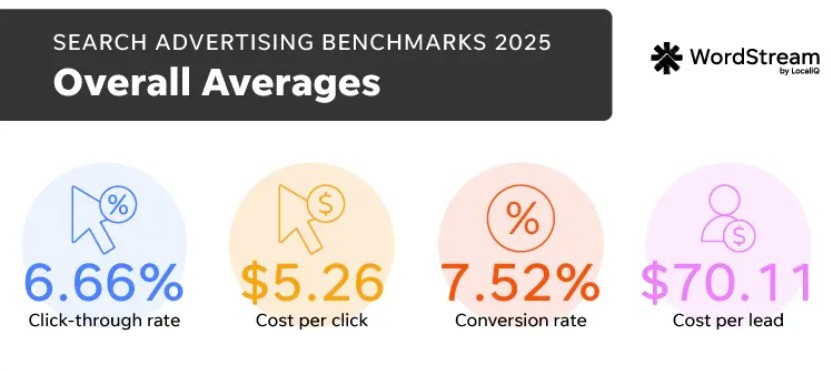
While, yes, you can’t put a number on the cost of Google Ads, whether per click, campaign or lead, benchmarks can serve as a handy yardstick to point you in the right direction. Lucky for us, the bright sparks at WordStream have crunched the numbers for us, revealing that last year…
- The average click-through rate was 6.66%
- The average cost-per-click was £3.84
- The average conversion rate was £5.50
They also divulged that the average GAds starting budget for SMBs was £730–1500 approx., with most businesses spending something between £730 and £7,300 per month.
Industry Variation
Because of the competitive nature of Google Ads bidding and the complexity of its algorithm, it’s pointless taking the average CPC above as gospel.
It might be bang on for some – think: £5.29 CPC for businesses in the British insurance industry – but much lower for other sectors like eCommerce or pharmaceuticals, the latter of which Statista recorded at just £0.19 in 2024. It can even vary within industry niches. SaaS companies, for instance, report average CPC between £4.17 and £2.05 in Search and Display, respectively.
As such, it’s worth looking at the specific benchmarks of your industry to see whether you belong to one of Google’s most competitive (ahem, expensive) business services verticals. Here, the cost reflects the higher potential revenue a client could yield.
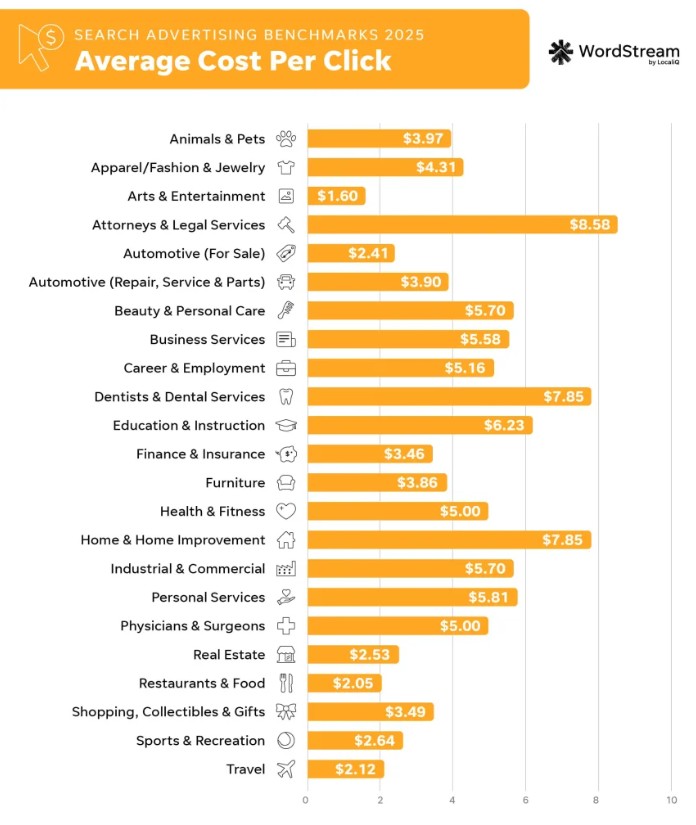
Looking at the data above, it tells us that, in the UK, Google Ads typically range between £0.50 and £5.00 per click.
A word of caution
Again, remember that these averages are only ballpark figures; you can only really know what Google Ads charges you when your specific campaign is set up and running. The important thing is to learn to optimise the card you’ve been dealt, so you can make your money go as far as possible.
Cost-Per-Click Versus Cost-Per-Lead
Before we all get too gung-ho about CPC, it’s important to ground the metric in reality. Alone, they don’t have any inherent value – after all, a £2 click that never converts is less valuable and, indeed, more wasteful than a £10 click that becomes a customer or even a returning customer later down the line. In short, it doesn’t tell you anything about the outcomes.
Cost-per-lead, however, fills in some of the gaps. It’s the average cost to generate an enquiry (call, form fill, booking, quote request) and measures intent, which gives you a much better picture of the commercial reality.
That said, though, not all leads are equal. Granted, some might be genuine, but they might spend less than you’d ideally like. Some people accidentally call, while others check the price and never get back to you. It’s all about volume, not quality.
The Secret Third Option: Revenue Efficiency
One way to side-step the issues above is to start thinking about revenue efficiency – i.e., how efficiently ad spend is turned into real business gains like qualified opportunities, revenue and return on ad spend (ROAS).
By segmenting your leads into the genuine ones, analysing cost per opportunity and comparing conversion value against spend, you can effectively weed out the dud leads and put your budget where it matters.
Cost Drivers that Make All the Difference…
Besides industry variation, there are numerous other factors at play that collectively determine the price Google’s PPC charges. I don’t have time to drill down into all of them, so here’s a whistle-stop tour of the main ones. Here goes nothing!
Keyword match type
Altering the targeting precision of your campaigns has a direct correlation with the cost per click. Broad match, which maximises exposure and reach, tends to result in lower CPC but simultaneously increases the risk of wasted spend through irrelevant queries. There’s a reason it’s favoured for finding new keywords!
On the other hand, high-intent exact match keywords are often more expensive, yet provide greater control, conversion rates and ROI. To succeed, you’ll need to strike the right balance and resist the temptation of “cheap clicks”, which fail to translate into quality leads.
Competition density & geographical targeting
This one’s self-explanatory: as the number of advertisers bidding on the same search term climbs, so increases the cost to secure a top position as the auction pushes bidders to pay for greater visibility.
Closely linked is geographic location; the more sparse an area, the fewer people there are to target or perhaps even fewer competitors to run against, depending on your niche. Likewise, if you’re based in a lucrative, densely populated area, you can expect a higher CPC.
Customer lifecycle
Another factor to note is the lifecycle of your customer or customer segment. In the era of ‘the messy middle’, where customer journeys are more convoluted than ever, it may take numerous touchpoints to warm up your leads enough before they actually click and/or convert.
For instance, a potential customer in the discovery stage might do some snooping on your website, download a bit of content or check out your social media before committing to your brand. Alternatively, it could be a previous client re-encountering the business as part of your retention marketing campaign.
Current trends
Lastly, let’s talk about the impact of consumer trends. Here, I mean seasonal fluctuations – for example, a rise in competition from January to March for holiday-related keywords as the peak booking season gets underway – as well as broader industry disruptions such as supply shortages or weather events. I need not remind you how the world of e-commerce skyrocketed during the throes of the COVID-19 pandemic.
Factors You Have Active Control Over
Reading some of the above, you might assume that CPC is by and large out of your hands. But what if I said that there’s plenty you can do to turn otherwise useless leads into valuable sales? Here’s how to squeeze the most out of your Google Ads budget.
Optimisation All The Way Down
A prerequisite for cost-effective campaigns is exploiting the full potential of your keywords by both choosing them well and managing your account effectively. This means striving for the maximum optimisation, at every level.
A good place to start could be aligning your SEO and PPC teams, sharing crucial keyword insights and consumer behaviour signals to align intent and refine your targeting.
Remember what I said earlier about Quality Score underpinning CPC? Well, it also applies here. With a more holistic view of your audience, you can drastically improve ad relevance and structure. Throw in your web developers’ expertise and ensure your site has all the right features, and your landing page experience will soar. Together, these improvements shrink bounce rates, drive higher conversions and improve lead quality
Tracking Genuine Leads, Not Just Volume
Google Ads’ algorithm now optimises towards what you feed it, which is why failing to optimise for clicks, calls, form fills, and so on can actively increase wasted ad spend. The bottom line is this: if you don’t tell Google which leads are genuine, it will push for volume over value.
So, what to do? My recommendation is investing in a server-side tracking tool like WhatConverts to supply your campaigns with accurate, real data to scale. This way, you can get to know your website visitors, assign value to the right leads, dismiss the rubbish ones, and get Google to concentrate on those worthwhile clicks.
The Hidden Money-Sink of Follow-Up Failure
The story doesn’t end when the clicks roll in; after all, lead capture is a vital phase of the sales funnel and, in 2026, it’s all about speed.
That’s the stark reality of paid search nowadays: tardy replies equal lost sales. When almost 80% of customers buy from the first business that responds, you’ve got to be on it with the follow-ups. If you already have a CRM, it’s worth seeing if you can integrate it with Google Ads or consider moving to one that does. This is a simple yet effective way to automate the grunt work and ensure no leads fall through the cracks.
Of course, the additional software will add to your PPC bill, but weighing up the cost-effective benefits, it’s well worth it.
DIY Versus Managed
Our final cost factor to evaluate is whether you’re barrelling straight down the DIY route or opting for professional PPC management.
Going It Alone
Doing it yourself is often the cheaper way to go; you’ll be paying something between £500–£10,000+ / month for the clicks and ad spend and then £50–£500+ / month for tool subscriptions.
In my book, it’s only worth doing this if you’re confident and experienced enough to start off on the right foot – you don’t want to blow budget on the learning curve.
Professional Management
Agency or freelancer fees usually sit around 10–30% of your ad spend, but it varies with the scope of your campaign and company in question. Often this averages out at £300–£2,000+ / month, give or take.
I recommend this latter option for beginners, since it’s the best way to make the most of your ad spend. You’ll likely find that they’ll absorb the cost of expensive tools and have the expertise to make quick calls on the fly and master niche applications like Google’s CSS Partner program – a goldmine for eCommerce brands looking to save on CPC.
Conclusion: Deciding Whether Google PPC is Worth the Price for Your Business
So, is PPC with Google Ads expensive? Not at all – poor measurement is.
With CPC ranging roughly between £0.50 and £5.00 per click for UK businesses, it remains a cost-effective and profitable means of getting your products or services in front of the right eyeballs. Provided you optimise for your audience, use clear-cut data and work from a place of expertise.
Ready to jumpstart your campaign? Then get in touch with the friendly team at Vital – we’ll connect you up with our PPC gurus and get those qualified leads pouring in.
Frequently Asked Questions
For the most part, absolutely – PPC typically delivers a 200% return on investment, and if the right factors align, you can even exceed this goal. Just make sure that you’ve finessed your targeting, you’re using accurate data, and that your product can tolerate the Google Ads cost (particularly in pricier industries like law). You’ll also need high-quality management from the get-go to avoid wasting your ad spend.
The reason is simple: because the Google Ads pricing model is structured on a real-time, auction-based system, rather than on a fixed fee basis. As such, the cost-per-click is influenced by supply and demand, competition levels, and the perceived value of a customer in your given market. That’s why, for instance, eCommerce ads are far cheaper than those for, say, insurance.
It can be, but it requires real skill, experience and the right tools to cut through the competition, and that necessitates a steep learning curve where it’s easy to blow your budget learning on the go. We’d always recommend hiring a professional to get the most out of your money, and so that you can preserve time for what you do best – running the business.
To catch wasted ad spend before it hurts your pocket, you’ll need to keep a close eye on your campaigns. The pros check in every day to monitor conversions and may even have automated rules/alerts for CPC spikes and other issues set up, so problems are flagged daily rather than in weekly reports.
Investing in third-party lead tracking software is another valuable option; with it, you can mark conversions (calls, form fills) as genuine leads, assign monetary value and filter out the junk. This all serves to make your campaigns smarter and more efficient.
Yes, lead tracking profoundly affects the price and efficiency of Google PPC campaigns. It’s as simple as this: if your ads are just generating traffic, with no measure of success, you’ll be wasting your money on dud leads.
However, by using tools like WhatConverts or Cometly, you’re able to track and qualify leads, feeding richer data back into the Google Ads algorithm, which will then shift its attention toward the keywords, audiences and placements that bring higher-value leads.


